Saturday, 11 November 2017

Nobel laureate Paul Crutzen 2006, conceptualised geoengineering as an 'escape route' from climate change, particularly, stratospheric aerosol injection. (Fig.1) Fuelling the divide further between  anti- and pro-. This post outlines the benefits and costs of deploying SRM.
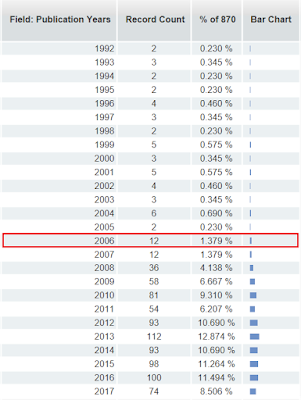
Fig.1 Screen capture analysing the total publications with 'geoengineering' in its title (source: Web of Science [Last accessed: 11/10/17]).


 Why?

In 2010, the International Risk Governance Council stated that an 80% reduction in CO2 emissions is required to avoid drastic climate change, (a report today shows increasing CO2 levels in China and India). In comparison, SRM approaches only require a small increase in the proportion of solar radiation reflected into space to significantly cool temperatures over a short period of time (Table 1), but it does not tackle the root cause of climate change, or, ocean acidification, only warming and thus often branded as a 'last resort'.

Table 1 Summary of SRM approaches taken from Calderia et al. (2013)
SRM method
Maximum cooling potential a
Attainable speed of deployment b
Relative cost per unit effect c
Relative risk to environment per unit effect d
Selected references
Space-based schemes
High
Slow
High
Low
Angel 2006, Early 1989
Stratospheric aerosols
High
Fast
Low
Medium
Budyko 1982; Rasch et al. 2008b, 2009; Robock et al. 2008
Whitening of clouds
Medium
Fast
Low
High
Latham et al. 2008, Rasch et al. 2009
Whitening of the ocean
Medium
???
???
???
Pres. Sci. Advis. Comm. Environ. Pollut. Panel 1965, Seitz 2011
Plant reflectivity
Low
Medium
Medium
High
Doughty et al. 2011, Ridgwell et al. 2009
Whitening of built structures
Low
Medium
Medium
High
Akbari et al. 2009, Menon et al. 2010

The quick deployment, high cooling, low cost and medium risk of stratospheric aerosols has incentivised research.


The case of stratospheric aerosols

Studies suggest that injection of sulphates into the atmosphere aids in the destruction of the ozone layer, enhancing incoming solar radiation, warming the planet and effecting public health. However, this is a short-term issue that is resolved over time as fewer chlorofluorocarbons (CFCs) can react with ozone particles. Using alkaline aerosol (calcite) in geoengineering could cool the planet whilst repairing the ozone layer, by neutralising acids from anthropocentric emissions. SRM could ensure the Earth remains below the agreed 1.5o C in Paris, and prevent sea level rise this century, saving coral reefs and halting the displacement of populations.

Another poignant argument against stratospheric aerosols is the promoted consequence of acid rain. The effects are robust in research, especially concerning the reduction and termination of freshwater fish populations, lake bacteria and causing forest dieback which in turn reduces food supply affecting forest bird communities. However, globally acid rain increase from sulphate aerosols is likely to be a moderate price to pay for global cooling, but, this depends on the amount of sulphur introduced into the atmosphere and amount converted into sulphuric acid. Using alkaline aerosols, as supposed to sulphates would also avoid this issue whilst simultaneously cooling the planet.  


The natural analogue for aerosol injection has been seen to have had no effect on climate other than reducing global temperatures. However, studies indicate that volcanic eruptions in the tropics induce changes in atmospheric circulation, warming continents in the Northern Hemisphere. Whilst eruptions at high-latitudes weaken the Asian and African monsoons by reducing precipitation over continents that subsist to stay alive, ie. Laki fissure, Iceland eruptions from 1783-84 caused famine in Africa, India and Japan. A global release of stratospheric aerosols will be problematic, but Scientists in 2007 released simulations of aerosol injection over isolated regions (the Arctic), this, however, would still reduce precipitation over wide regions and succumb populations to drought and climate variability. 
 
Contentious ethical issues arise concerning SRM. The unilateral implementation of this method creates apparent winners and losers. The issue of governance and who calls the shots? is critical, SRM may induce conflict or the 'weaponising of nature' (Geostorm film).


Conclusion

The cooling capabilities of SRM are enticing despite the implications it may have on earthly systems. Alan Robock (2012) states:
Testing of geoengineering should be indoors for the foreseeable future, either in computer models or laboratories, without potential to affect the environment. Only once we feel that we have developed a good understanding of a potential system and have devised an outdoor test that is crucial, should it go ahead - pg204 
In contrast, I believe SRM will be implemented overtime. The potential to halt sea-level rise and global warming may change perceptions on SRM to save key habitats of magnificent species like the polar bear. However, SRM should not be viewed as an 'easy fix', we must continue to change global consumption patterns and energy infrastructures the tipping point.
.

 I only see SRM working properly under a utilitarian power, leaving me with conflicted feelings over who the winners and losers are. Should we really have all this power?

Friday, 3 November 2017


Solar Radiation Management (SRM), is another form of geoengineering aiming to manage and reduce incoming solar energy reaching the Earth, to counteract GHG forcing. Models indicate that the climate system reacts quickly to artificially reduced insolation, and therefore SRM is often branded as a last resort against 'dangerous' warming.


Fig.1 Illustration of geoengineering approaches (source: IPCC / Royal Society).
  1. Stratospheric aerosols

    1. Extensive studies have shown major volcanic eruptions to cool global temperatures over short-timescales (Fig.2). The ejection of sulphate particles in the stratosphere from eruptions causes an increase in diffused solar energy and reduction in total energy reaching the Earth. A natural analogue for the stratospheric release of sulphate aerosols. According to models cooling could start within months of release and cool significantly within decades. Thus, receiving growing traction from scientists and policymakers. 


      Fig. 2 Mean global average temperatures from 1970-2012 with major volcanic eruptions highlighted (source: Kosaka & Xie, 2013).
  2. Albedo enhancement

    1. Approaches that aim to enhance the reflectiveness of surfaces (land, oceans and clouds) to increase the amount of solar energy reflected into space. For instance, painting cityscape roofs white as suggested by Barack Obama in 2009, to seeding marine clouds to enhance the total of cloud condensation nuclei (CCN) present, thus increasing cloud surface area and brightness. 
  3. Space reflectors

    1. Roger Angel (2006), presented the idea of 100 000km wide 'sunshades' (aka space reflectors) to be placed in outer space.  Reflecting and/or blocking incoming solar radiation. Calculating that only ~2% of incoming solar radiation would have to be blocked to offset current warming. In line with calculated energy transfer figures.

Fig.3 An article headline from NY Times (source: Friedman & Thrush, 2017) 
However, a consensus within the scientific community is that SRM is bad and infeasible (I'm a little on the fence about it too). A contemporary argument for this would be the justification for the Trump administration to deny climate change (despite the arguments many USA scientists make Fig.3), disregarding the Paris Agreement and continuing fossil fuel exploitation (ie. pipeline exploration destroying indigenous lands and fracking).

Conclusion

Initially, SRM seems to be a viable climate fix. However, SRM is controversial and prone to issues surrounding governance, equity and ethics. 

However, there may be a place for SRM especially if we adopt the business-as-usual approach to climate change. SRM may 'save' us and provide us time to change current social, economic and environmental practices. In this regard, I perceive SRM to be a form of adaptation and not mitigation.

Saturday, 21 October 2017

You may be led to believe that climate change is a recent issue- it isn't! (the first publication regarding climate change dates to 1900s, Fig.1).  Kyoto, 1997 was a milestone proposing a global solution to climate change (the reduction of 6 greenhouse gases (GHGS) by 5.2% below 1990 levels), succeeded by the Conference of Parties (COP), occurring annually since 1995 and the International Panel on Climate Change (IPCC). These conferences are fundamental in our quest to tackle climate change.

But are we really any closer to a solution?

Fig.1 Screen capture analysing the total publications with 'climate change' in its title (source: Web of Science [Last accessed: 11/10/17]).

James Hansen, the founder of modern global climate change awareness, strongly disagrees. Branding the recent Paris, COP21 conference as a "fraud" and "fake" stating:
“It’s just bullshit for them to say: 'We'll have a 2C warming target and then try to do a little better every five years.’ It’s just worthless words. There is no action, just promises. As long as fossil fuels appear to be the cheapest fuels out there, they will be continued to be burned.”
 Atmospheric concentrations of carbon dioxide (CO2) have risen drastically over the past century, ∼280 ppm (pre-industrialisation) to >380ppm (present day). Environmental reconstructions indicate that CO2 (and other GHGS) in the atmosphere are at their highest.

Stimulating the development of geoengineering techniques that remove CO2 from the atmosphere, and counteract anthropogenically driven greenhouse effects and ocean acidification. Known as Carbon Dioxide Removal (CDR) (Fig.2).


Fig. 2 Illustration of CDR approaches that 'suck' carbon from the atmosphere storing elsewhere (source: Sheperd, 2015)
  1. Afforestation & Artificial Trees

    1. A Global-scale tree planting effort to capture CO2 through photosynthesis - deforestation accounts for the second largest anthropogenic source of CO2 emissions in the atmosphere.
    2. Implementing artificial trees, a large, fly-swat shaped construction that absorbs passing air by using a sorbent (sodium hydroxide), results in CO2 in the atmosphere being separated and stored naturally in the Earth.
  2. Biochar & Bioenergy 

    1. Biochar can be produced through the heating biomass under reduction of oxygen (processes are known as pyrolysis or gasification). Therefore, no CO2 is produced and released into the atmosphere and "carbon negative".
    2. Bioenergy is produced alongside biochar and could displace our global fossil fuel usage - the primary source of CO2 in our atmosphere. Aiding in the reduction of other GHGS emissions. The carbon sequestered in biochar is stable (for up to 2000 years) and can be used as a fertiliser.   
  3. Direct Air Capture

    1. The construction of large machines that extract CO2 directly from the ambient air and sequestered underground or in the ocean. 
  4. Iron Fertilisation

    1. Roughly 30% of the world's oceans have low rates of primary production because of low iron concentrations. Therefore, the addition of micronutrients particularly iron onto oceans are shown to promote large-scale planktonic blooms that draw down CO2 from the atmosphere via photosynthesis.
  5. Enhanced Weathering & Ocean Alkalinity Enhancement 

    1. When fresh exposed olivine is in contact with CO2, magnesium carbonate and silicic acid are formed. Stimulating the removal of atmospheric CO2 stored in the rock that can be deposited onto soil or the ocean bed, tackling ocean acidification.
    2. Scientists suggest that enhanced weathering and dusting of finely ground minerals over surfaces, enables more CO2 to be sequestered and promote ocean biological productivity, sucking more CO2 in.

Conclusion

The CDR techniques present key opportunities for society to mitigate against climate change. These should be methods to be implemented with global reductions of CO2 and not as a means to justify the business as usual approach. Much of the science and implications of implementing these approaches is unknown and expensive (seen in upcoming posts). 

.

Climate change is a 'hot' issue that is heavily politicised, and like James Hansen, I believe we are no closer to finding a global solution to climate change and geoengineering may be pointless. We could tackle the issue head-on and address the politics of fossil fuels, but instead, we direct efforts towards technology to mitigate, despite not fully understanding its implications on earth systems. A decision must be made: Continued economic growth? or, reversing climate change? 

Tuesday, 10 October 2017

Today a peer asked me what my blog was about. I replied casually with "geoengineering" (like everyone's heard about it), instead, I was met with the fantastic question "what's that?"

Today, the term climate change has never been so prevalent; we are immersed in the media with the implications that will inevitably arise. We are often so caught up with all the doom and gloom that we forget to actively find ways to mitigate and/or adapt to our changing climate.  The recent Paris Agreement is a great example of this, aiming to limit the global temperature rise to 1.5°C - 2°C above post-industrial temperature, but achieving this requires greater levels of mitigation planning than we currently have.

This problem has provoked greater thought on climate geoengineering methods: a global-scale, deliberate, alteration of the Earth's climatic systems designed to counteract or offset climate change. These approaches can be divided: 1) carbon dioxide removal technologies: extracting excess CO2 from the atmosphere and storing or 2) solar radiation management: reducing the amount of sunlight reaching the planet, thereby reducing the greenhouse effect. Despite increasing interest, limited attempts have been made to inform the public of these potential methods being devised by scientists and engineers to 'fix' our climate. Its ethics are often critiqued, and it must be made clear to the public, as global stewards we are responsible. The philosopher Friedrich Nietzche (1882) stated: 

"The time is coming when the struggle for dominion over the earth will be carried on. It will be carried on in the name of fundamental philosophical doctrines"
A philosophical thought to be considered throughout the blog as we tackle the array of methods designed to fix our planet.

.


Stay tuned for my future posts to learn more, but if you can't wait check out the newspaper headlines to understand why geoengineering is so important today!